
Artificial Intelligence
AI in your app, from prototype to store
I integrate Artificial Intelligence into apps and systems — Android, iOS, Web and Desktop — so your product understands natural language, automates tasks and genuinely helps your customers. Backed by solid software engineering, not just a chat box.
The market has changed
AI is now part of the experience — and of work
Talking to an assistant, asking for a summary or searching by describing something in your own words has become a habit. Anyone opening an app today expects it to be smarter: to understand the request, anticipate the next step and save time.
For companies, the shift is twofold: AI unlocks new product features and changes how work gets done — in support, operations and software development itself. The question is no longer “whether” to use AI, but “where it creates real value” and “how to run it in production safely”.
New expectations
Users want to talk to apps the way they talk to people — and get answers right away.
New products
Features that once required months of research now fit into a single development cycle.
New ways of working
Repetitive tasks move to AI, so your team can focus on what needs human judgment.
What you can build
AI solutions for your product
Every project starts with the problem, not the technology. These are the kinds of solutions that deliver the most results in apps and systems:
Assistants and chatbots
Assistants in your app, website or WhatsApp that answer from your company’s information, keep the conversation’s context and hand off to a person when needed.
Smart search
Semantic, natural-language search: users type “quiet restaurant for a meeting near the subway” and the app understands the intent, not just the words.
AI agents
Agents that use tools: they query your APIs and databases, fill in forms, schedule and run multi-step workflows — with clear rules and limits.
AI on your own data (RAG)
Answers grounded in manuals, contracts, catalogs and internal knowledge bases, with sources — without training a model from scratch or exposing sensitive data.
Computer vision and OCR
Reading documents, license plates, receipts and photos straight from the camera, processed on the device when privacy or connectivity require it.
Content and automation
Summaries, message classification, data extraction, translation and text generation — repetitive tasks that no longer tie up your team.
In practice
AI already in the stores
Published projects where Artificial Intelligence is part of the product:

Social Discovery
Levii
Smart natural-language search: people describe what they are looking for in their own words and the app finds matching people, circles and experiences — always explaining the reason behind each suggestion.
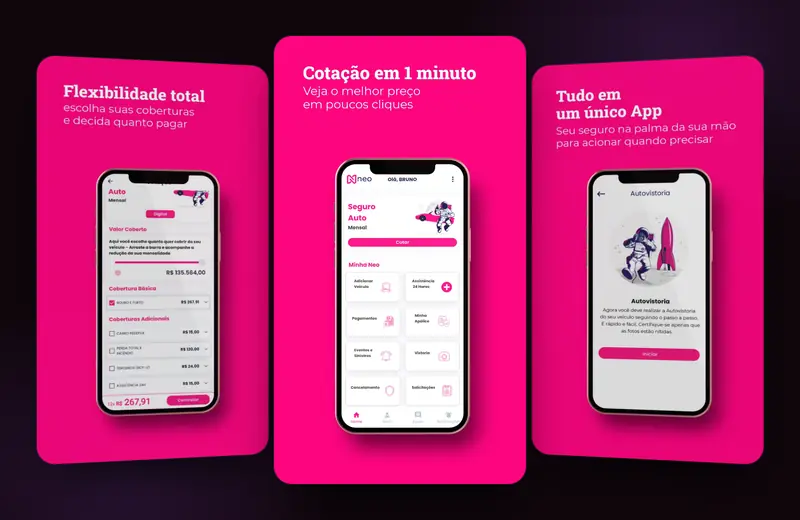
100% digital car and pet insurance
Neo Seguradora
Phone-guided self-inspection with computer vision: the camera and ML Kit text recognition read the vehicle’s information right on the device, making the inspection faster for customers.
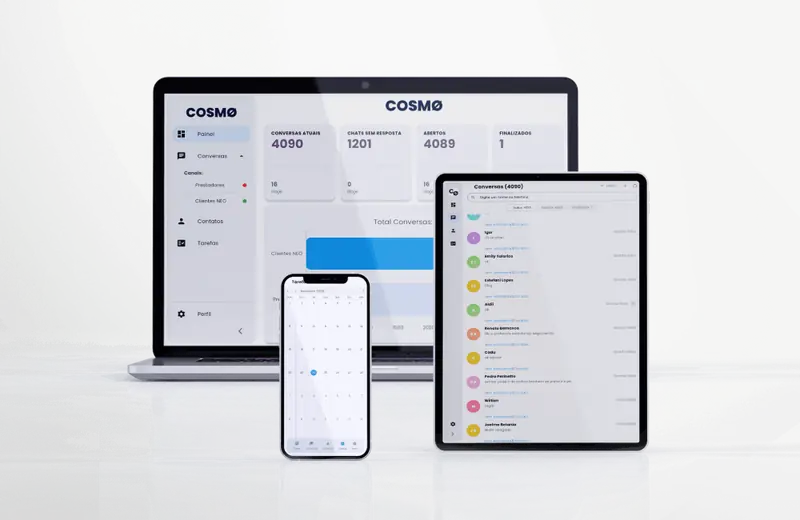
CRM, Chatbot & AI
Cosmo CRM
Cross-platform app for a customer service platform with chatbots and AI: conversations, the lead funnel and automated flows reach the team on Android, iOS, web, macOS and Windows.
How it works
From discovery to production
Discovery
We map the process, the available data and where AI saves time or drives revenue. Sometimes the best answer is a simple rule — and I will tell you so.
Fast prototype
A short proof of concept with real data to validate answer quality, cost per use and user experience before investing in the full project.
Product integration
AI goes into the app and backend with an interface designed for it: real-time responses, confirmation before important actions and a fallback when the model fails.
Measure and improve
Automated evaluations, cost and quality monitoring, and continuous tuning of prompts, models and data based on real usage.
Responsibly
AI that is safe, predictable and yours
Privacy and data protection
Sensitive data handled with care: anonymization, on-device processing when possible and providers that do not train models on your data.
Costs under control
The right model for each task, caching and usage limits: the bill never grows without you knowing.
Verifiable quality
Answers tested against real cases, safeguards against misuse and a human in the loop for important decisions.
No vendor lock-in
An architecture that lets you switch models — Claude, GPT, Gemini or open source — as prices, quality and the market evolve.
How I work
AI-accelerated development, reviewed by an engineer
I use AI tools every day to prototype, write tests, review code and document. That shortens timelines and frees up time for what matters most: architecture, user experience and quality. Everything that ships to production goes through human review, tests and the same standards as always.
- Prototypes and MVPs in less time
- More tests and documentation in every delivery
- Human review on everything that ships
FAQ
Questions about AI
Do I need a lot of data to use AI in my app?
No. Today’s language models come ready to understand and generate text; in most projects, it is enough to connect the information you already have — catalog, manuals, support history. Training your own model is rarely necessary.
How much does AI integration cost?
It depends on usage volume and complexity. There is the development cost and the model usage cost, usually billed by the amount of text processed. I estimate both during discovery, and the prototype shows the real cost before you invest in the full project.
Is my data — and my customers’ data — safe?
That is a project requirement, not a detail. I favor APIs and plans that do not train models on your data, strip sensitive information before sending it whenever possible and, in some cases, process everything on the device so the data never leaves the phone.
Can AI be added to an existing app?
Yes. In most cases, AI comes in as a new feature — an assistant, a search, an automation — integrated with your current app and backend, without rewriting the product.
What if the AI makes a mistake?
It can, and the project has to plan for that: answers grounded in verifiable sources, user confirmation before important actions, clear limits on what the assistant can do and an easy path to a human.
Which AI model do you use?
Whatever fits each case best. I work with models such as Claude, GPT and Gemini, and with smaller or open-source models when cost, privacy or offline use call for it. The architecture lets you switch models without rebuilding the app.
Got a process AI could handle?
Tell me how it works today. I’ll help you find where AI creates real value — and where it isn’t worth it.